
From The Workshop
What to Look for in a Deck Builder in Sydney
A new deck is a major investment in your home — often $20,000, sometimes more. The person you let onto your property to build it should clear the same bar you’d apply to anyone you’d trust with something that matters. Most guides on hiring focus on licences, quotes, and references. Those things matter — they’re how you build a shortlist. But once you’ve got two or three builders who all tick the same boxes on paper, the deciding factor sits somewhere else entirely. This post is about where.
Below is what I look for when I’m the client buying a trade — and the same standard I’d want to be assessed against. Use it on me. Use it on anyone else you’re considering. The list works the same way regardless of whose business is on the quote.
Where the Real Differences Sit (Once Checklists Are Cleared)
The checklist stuff — licence number, insurance certificate, written contract — is the floor, not the ceiling. Most builders worth shortlisting will clear it. Once you’ve filtered for that, the meaningful differences between candidates aren’t on paper. They’re in how the person operates day to day — and the only way to read that is to know what to look for.
Here’s the thing nobody says out loud. A deck is a months-long relationship. The builder will be on your property when you’re not home. They’ll be making hundreds of small decisions you’ll never see — how to handle a joist that’s slightly bowed, whether to add an extra cleat where the spec is silent, whether to clean up properly on a Friday afternoon when they’re tired. Those decisions are determined entirely by the kind of person they are. No quote document covers them.
So the question worth asking isn’t “is this builder qualified” — it’s “is this someone I’d trust to make hundreds of small calls on my behalf when nobody’s watching.”
The Five Traits That Separate the Right Builder From the Rest
Five traits. These aren’t unique to my trade — they’re what anyone with sense looks for in a person they’re about to spend two months working alongside. None appear on a licence card. All show up in how someone talks, quotes, and operates. Read them as a test you apply, not as a list of claims I’m making about myself.
Honesty
The honest builder tells you when a job is harder than it looks. Tells you when your idea won’t work and explains why. Tells you when the timeline you want isn’t realistic. Tells you the actual price, not the lowball that becomes a different number once the boards come off.
You see honesty in the quote. A vague one-page quote with a single lump sum is almost always hiding something — usually the substitution risk on materials. An honest quote names specifications down to the joist spacing, the fastener type, the brand of board. Not because the builder’s showing off, but because they want everyone to agree what’s being built before a cent changes hands.
You see honesty in how someone answers a question they don’t have a good answer to. The honest builder says “I don’t know, let me check” or “that’s not really my area, you’d want a structural engineer for that one.” The dishonest one bluffs.
Integrity
Integrity is what someone does when nobody’s watching. In this trade, that means the framing under the boards, the flashing behind the ledger, the cleanup at the end of the day. The boards are what your guests see — the frame is what proves who the builder actually is.
You can’t inspect integrity at quote stage. You can ask for it indirectly. Ask to see a job in progress. Look at the frame work before the boards go on. Look at how the offcuts are stacked, whether tools are tidy, whether the bins are emptied. None of that is glamorous, but it’s the daily evidence of whether someone takes pride in work that won’t be seen.
Passion for the Work
This one is harder to fake than people think. A builder who actually loves the trade gives themselves away in conversation. They talk about specific timbers — why Spotted Gum behaves differently from Merbau, why hardwood acts up in coastal salt air, when composite makes sense and when it doesn’t. They have opinions on joist centres. They get animated about a tricky angle on a previous job.
The opposite is the builder who treats every deck the same and uses the words “approximately” and “around there” a lot. Passion shows up as specificity. Indifference shows up as generality.
This matters because passion is what stops corners getting cut on the bad days. Anyone can build well when they’re fresh and motivated. The question is what gets built on the third rainy day in a row in week six of a project. Passionate builders still build to standard. The rest don’t.
Accountability
Accountability is about who owns the work twelve months from now. Look for it in two places.
First, the warranty. Not the paper one — every licensed contractor has the legal minimum on paper. The real warranty is what someone does when you call them eighteen months after handover because something’s not quite right. Builders with no accountability don’t pick up. Builders with accountability come back and have a look, even when it’s inconvenient, even when it’s outside their official obligation.
Second, the language someone uses about past mistakes. The builder with accountability says “yeah, on my second pool deck I got the bearer spacing wrong and had to redo half of it — that’s why I’m so particular about it now.” The one without says everything they’ve ever built was perfect. One of those statements is honest. The other isn’t.
Responsibility
Responsibility is about who’s actually doing the work and who’s making decisions on your project. The responsible builder is the one quoting, framing, finishing, and answering your calls — not a sales rep who’s never picked up a tool, not a different crew every Monday, not whoever happens to be available that week.
This is hard to verify with companies that subcontract. The quote comes from one person. The work gets done by people you’ve never met. The accountability for problems sits in a gap between the company and the subcontractor, and you fall into that gap when something goes wrong.
The responsible builder makes themselves the single point of accountability by being on the job every day. When something needs to be decided, they decide it. When something goes wrong, they own it. There’s no “the subcontractor was supposed to do that.”
Why These Traits Almost Always Trace Back to the Owner
When you find honesty, integrity, passion, accountability, and responsibility all in one builder, you’ve almost always found a business owner who is also the tradesperson. That’s not a coincidence.
Owner-operators have skin in the game in a way that employees and subcontractors don’t. The work is their reputation, not someone else’s. The client is theirs, not assigned by a project manager. The decade-long stream of referrals depends on every deck still looking good five years later, not just looking good at handover. That changes how every small decision gets made.
This is the standard I try to hold myself to with my own clients. I’m the lead carpenter on every Decksmith build. I quote, frame, board, finish. I’m on site for every stage. When something goes wrong, it’s mine. When something goes right, it’s mine. That kind of accountability is harder to deliver at scale, which is why the businesses I respect in this trade are mostly small ones. Volume tends to dilute it. More on how I work as a deck builder in Sydney.
The character of the builder shows up in the deck. Skill builds the surface. Character builds what’s under it.
Practical Ways to Test for Each Trait Before You Sign
You can’t make people prove they’re honest. But you can structure your shortlisting process to surface evidence of each trait. Here’s the short version.
Test for honesty
- Ask a question you already know the answer to (about timbers, fasteners, regulations). See whether the builder answers accurately or bluffs.
- Ask for a worst-case scenario on cost and timeline. The honest builder gives you one. The dishonest one tells you everything will go perfectly.
- Compare quotes side by side. The honest quote is detailed and slightly more expensive than the lowest one. The lowball is almost always hiding scope.
Test for integrity
- Ask to see a current build, not a finished one. Look at the framing, the cleanup, the tool care.
- Ask what the builder would do if they discovered a defect halfway through the build that wasn’t visible at quote stage. The integrity answer is “I’d stop, tell you, agree the fix together, then keep going.” The bad answer is “I’d just deal with it.”
Test for passion
- Ask the builder what their favourite deck they’ve built was, and why.
- Listen for material specificity. A passionate builder will get into the difference between board types unprompted.
- Ask what they hate about this trade. Passionate builders have strong opinions. Indifferent ones don’t.
Test for accountability
- Ask for a reference from a client whose deck was built more than twelve months ago. Not a recent one. A year-old one.
- Ask how the builder handles a warranty callback at the eighteen-month mark.
- Ask whether they’ve ever had a dispute with a client. The accountable answer is honest about it. The unaccountable answer claims it’s never happened.
Test for responsibility
- Ask who specifically will be on site each day of the build.
- Ask what happens if that person is sick. (The honest answer is “the job pauses until I’m back.” The fudge is “we have a team rotation.”)
- Ask whether the builder uses subcontractors and for what.
The Cheapest Signal Nobody Mentions
There’s one signal that costs you nothing and tells you almost everything, and most homeowners ignore it: your gut.
After you meet a builder at a site visit or take a phone call, ask yourself a simple question. Would I want this person on my property for the next eight weeks? If the answer is “not really, but the price is good” — walk away. The price is never good enough to compensate for two months of friction with someone you don’t trust.
The flip side: when you meet the right builder, you almost always know in the first thirty minutes. The conversation flows. They explain things without condescending. They ask good questions about your house, your family, what you’re hoping the deck does for you. They don’t pressure you. They don’t oversell. You finish the conversation thinking “this is the kind of person I’d be comfortable with on my property.”
Trust that. Cross-check it against the harder evidence above. But don’t override it.
Where The Decksmith Sits
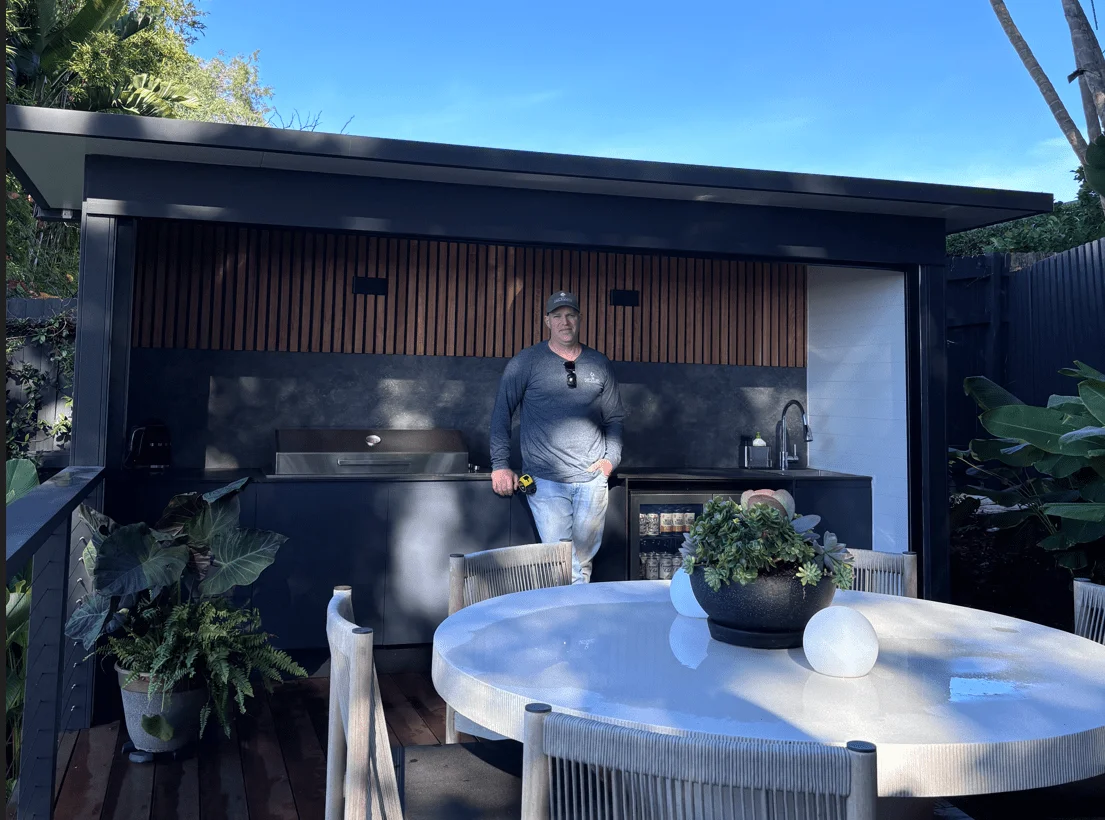
I’m Greg, founder of The Decksmith and lead carpenter on every Decksmith build. Licence 272840C, verifiable on the public register. Twelve years in business, 500+ decks across Sydney, Eastern Suburbs base with Sydney-wide work.
I work with a small team where the job requires more than one set of hands, but you won’t get the junior carpenter and the apprentice showing up to build your investment. I’m on site every day, every project, every stage.
Quotes turn around quickly. I run site visits Monday to Saturday. Quotes are prepared Saturday afternoon and Sunday for the week — unless your specs need a supplier confirmation on unusual materials, you’ll have your quote by Sunday evening of the week we meet. Most builders in this market take weeks or never get back to people. That’s a low bar and I’m happy to clear it. If you want a rough idea of how much your project might cost before we ever speak, the pricing calculator at the-decksmith-pricing-guide.netlify.app gives you a realistic range based on your specs. No email gate.
For social proof, read my Google reviews — the long-term ones (twelve, eighteen, twenty-four months post-build) are the ones that tell you whether the work held up. Those are the reviews worth reading.
Either way, do the checks. Trust your gut. The right builder will welcome every one of these questions, because the right builder has nothing to hide.
Get Your Deck Estimate
Use the calculator to see indicative pricing for your project.
Open Calculator