
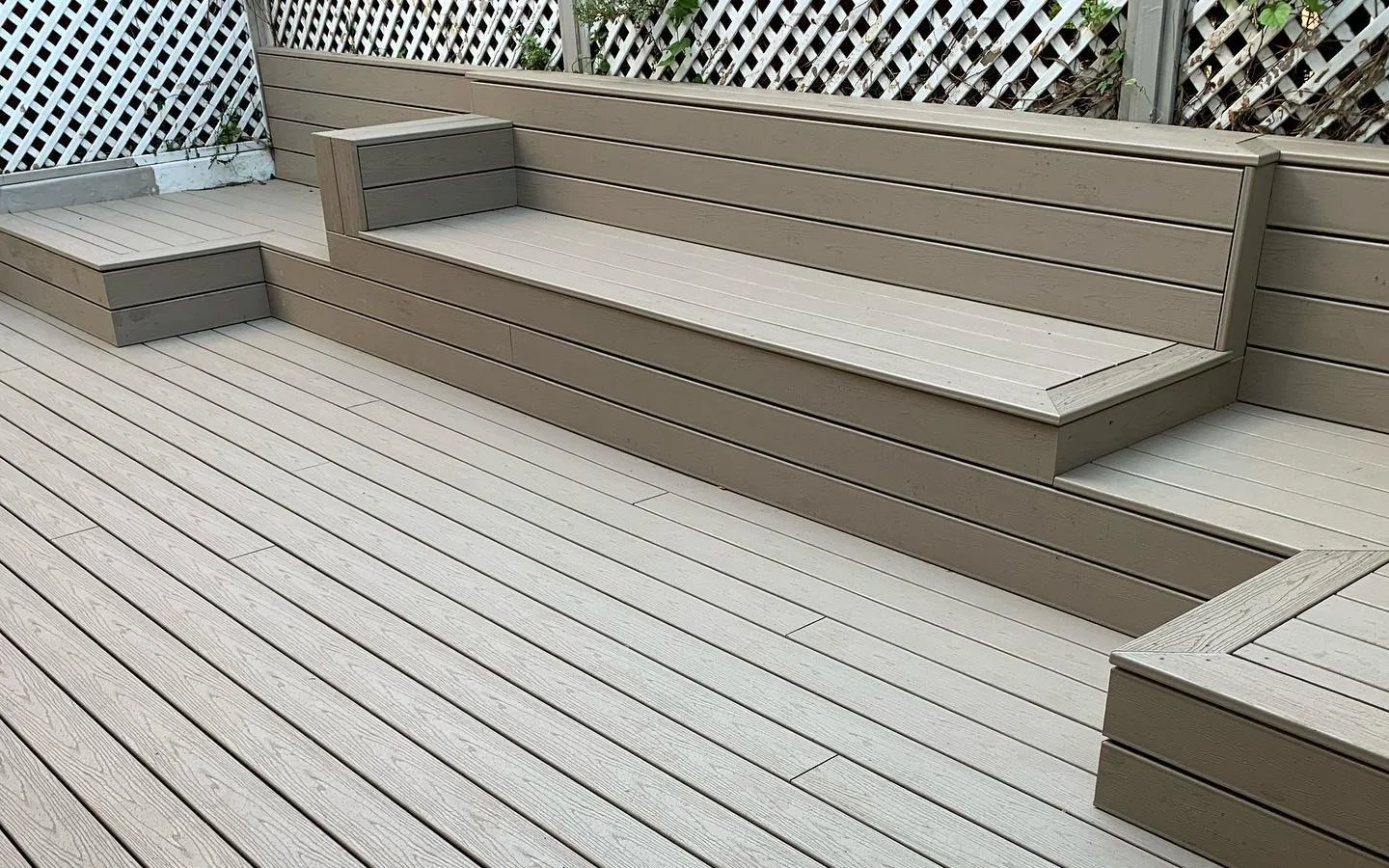
I’m Greg, The Decksmith — and I’ll be honest with you: I’m an old-school carpenter who spent years refusing to touch composite. Trex is the brand that changed my mind. Here’s the straight story on why, who it suits, and what it costs.
Trex has been named America’s Most Trusted outdoor decking by Lifestory Research every year from 2021 to 2026.
From timber diehard to Trex
I was raised on the beauty of timber — the grain, the smell, the unique pleasure of a good hardwood deck. When composite first hit the market I was dead against it, and I dug my heels in for a long time. It took a real estate agent client, who specified one of the early second-generation composite brands, to get me to lay my first board.
That job — and the ones after it — taught me some painful and costly lessons about the pros and cons of composite. The early boards I installed didn’t wear well, and for a carpenter who takes pride in his work, that stung. I became a bit of a composite snob, because I’d been burned by a poor product.
Then I found Trex — specifically the Transcend range, with its ultra-hard, wear-resistant capping. That was the moment I knew this was a brand I could actually get behind and put my name to.
The maintenance trap nobody tells you about
Most people choose composite for one reason: it’s low-to-no maintenance. No annual oiling — which, let’s be honest, almost nobody does, and almost nobody does right. In Sydney’s relentless sun and salt air along the coast, that makes composite the sensible choice for how people actually live today.
But here’s the catch, and it’s the thing I wish someone had told me early on: because composite is low-maintenance, you also can’t maintain it.
With a timber deck, if it looks tired after a few years, you sand it back and re-oil it and it shines like new. You can’t do that with composite. What you install is what you’ve got. So the wear resistance of the board you choose isn’t a nice-to-have — it’s everything. That’s the whole reason I’m so particular about brand, and it’s exactly why I land on Trex Transcend: that hard cap is what keeps the deck looking right in five, ten, fifteen years, when there’s no sanding-and-oiling to fall back on.
When I recommend Trex
I’ll almost always put Trex in the mix, and sometimes I’ll come close to insisting on it — most of all for rental properties, where the deck cops heavy use and there’s nobody babying it. Its toughness is exactly what you want when you can’t control how it’s treated. Same goes for busy family decks and hard, sun-exposed coastal spots.
Where might I point you elsewhere? If looks are your absolute priority above all else, I’ll be straight with you and talk you through Millboard too (more on that below). But for durability, value and peace of mind, Trex is the one I keep coming back to.
Transcend vs Lineage — and a word on colour
The two ranges I fit most are Transcend and Transcend Lineage. They’re closely related but there’s a real trade-off worth understanding:
Transcend has the toughest, most scratch-resistant cap — my pick where durability is the priority. The one honest caveat: in the darker colours it does get hot underfoot in full sun (that’s true of every dark composite, not just Trex).
Lineage is engineered to run cooler and has a slightly softer, more refined look — the aesthetic trade-off is a cap that’s a touch less scratch-resistant than Transcend’s. If heat underfoot is a worry, Lineage is the smarter starting point.
The last Lineage deck I built was in Rainier at Kyogle Street, Maroubra — 46 square metres including the stairs, on a completely rebuilt frame.
On colour, Havana Gold is probably the most popular I fit — but I try not to steer people on colour. It’s personal, everyone’s taste is different, and it’s one of the few parts of a deck that’s genuinely yours to choose. I can bring samples to site, or have them delivered; you pick what you love.
Trex Transcend at a glance
- Type
- Capped wood-plastic composite — recycled wood fibre + recycled polyethylene, with a hard protective shellTrex SDS / AU Install Guide
- Board size
- 140 × 25 mm · 5.48 m lengthsTrex 2026 AU Install Guide
- Max joist span
- 350 mm unshaded / 450 mm shadedCodeMark CM70206 (certified AU limit)
- Warranty
- 50-year residential (Transcend & Lineage); 25-yr fade & stainTrex Limited Warranty; trex.com/lineage
- Slip rating
- P5 — AS 4586 wet pendulumATTAR 18464-2 slip report
- Bushfire
- BAL-19 certifiedCodeMark CM70206
- Fixing
- Trex Hideaway hidden clips, or face-fixTrex Catalog / CodeMark
- Colours
- 7 in Lineage; 30+ across the rangeTrex Catalog 2026
- Certification
- CodeMark CM70206 — Australian building-code certifiedBureau Veritas
What “Trex Platinum Pro” actually means for you
Platinum Pro isn’t a badge you buy — it’s earned by installing a certain volume of Trex decks to a standard of workmanship and client service that Trex stands behind. In plain terms for you: you get an accredited installer, a correct, best-practice install, and a job that’s set up properly for Trex’s warranty to hold. With a product you can’t sand-and-oil back to life later, getting the install right the first time is the whole ballgame.
A Trex deck I’m proud of — Bundeena
Bundeena — BAL-rated bushfire site with Trex RainEscape
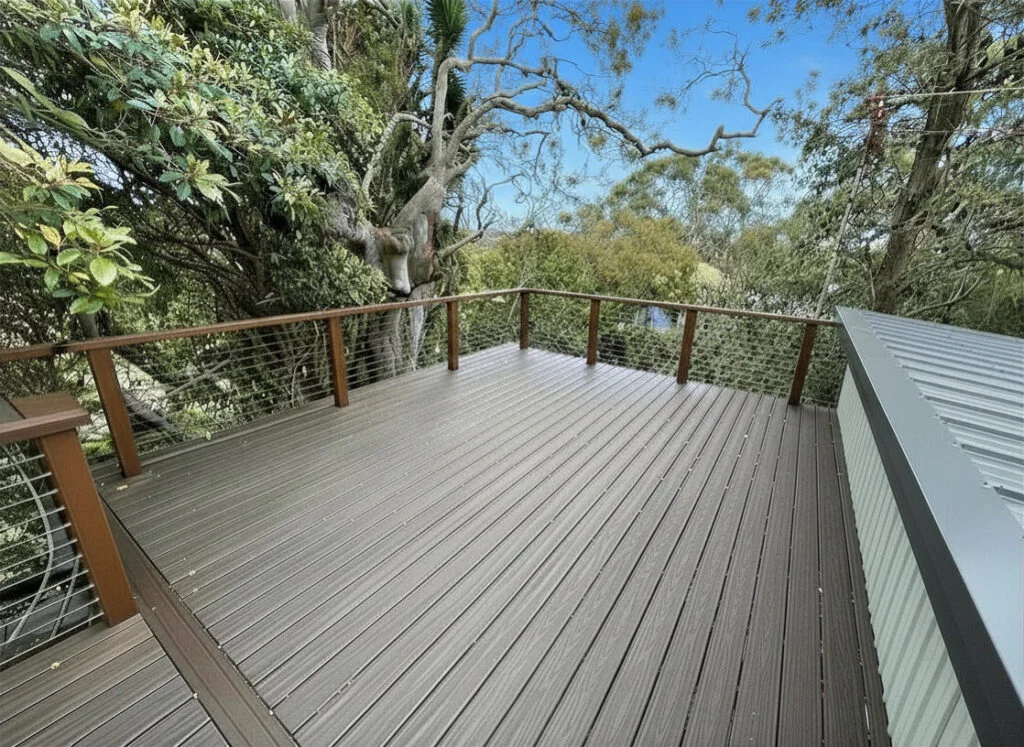
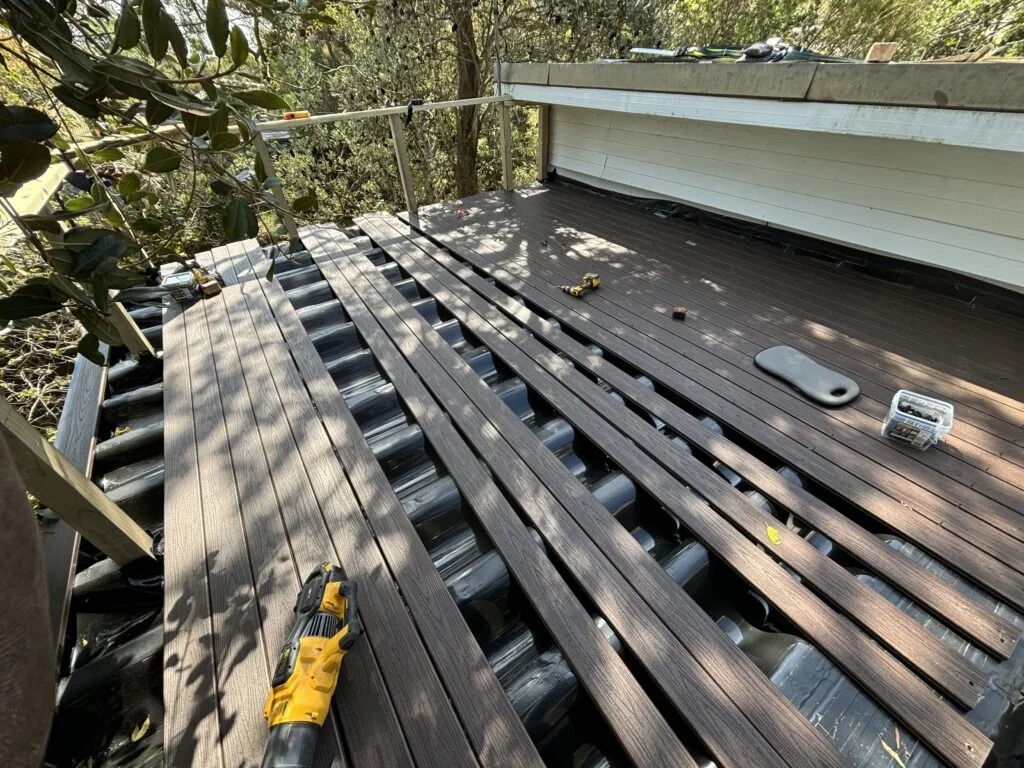
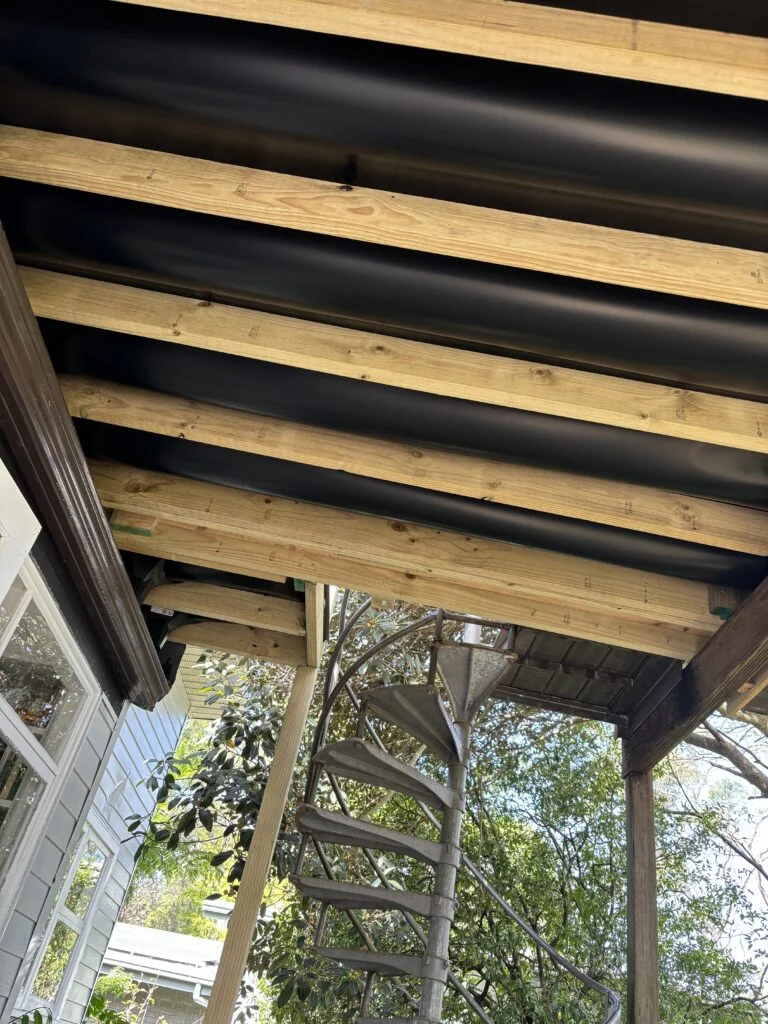
Bundeena sits in a bushfire-prone area, so this deck had to meet a BAL rating requirement — exactly where Trex Transcend’s BAL-19 certification earns its keep. I also installed Trex RainEscape, the under-deck drainage system that channels water away and keeps the space beneath an elevated deck dry and usable. It’s the kind of full-system detail that separates a deck that’s just built from a deck that’s built right.
Another Trex project to see: my Trex deck build in Mascot →
What a Trex deck costs in Sydney
As a rough guide, a Trex deck runs around $850–$900 per square metre, supply and installed. That’s genuinely good value for a 50-year-warranty board with this level of toughness.
Trex decking — common questions
How much does a Trex deck cost in Sydney?
Trex vs Millboard — which is better?
Does Trex get hot in the sun?
Can you sand or refinish a composite deck like timber?
What warranty does Trex come with?
Thinking about a Trex deck?
Tell me about your site and I’ll give you honest advice and an on-site measured quote.
Get a quoteWeighing up brands? See my full composite decking comparison for Sydney →