
From The Workshop
When to Replace vs Repair Your Deck in Sydney
I get it. I’d wonder the same thing.
So this post is the honest version. When a repair makes sense, when it doesn’t, and the one trap that catches most homeowners — the “just replace the boards, the frame’s still good” idea that almost never works the way people hope it will. After 500+ decks across Sydney, the patterns are clearer than they look from the homeowner’s side. Here’s what I tell people.
The Honest Default
If a deck has one specific problem — a damaged board, a stair tread that’s failed, a section of railing that’s loose, a small patch of frame rot near a downpipe — repair makes sense. Fix the thing, warrant the fix, move on.
If the deck is “getting old” in a general sense — boards weathered, frame feeling its age, multiple small issues appearing in different spots — replace makes sense. Band-aid repairs on an ageing deck cost more in the long run, and you end up living with a deck that looks tired and might be hiding worse problems underneath.
That’s the rule of thumb. The detail underneath it is what most of this post is about.
What Clients Call About vs What’s Actually Going On
The number one call I get for “I just need a small repair” is soft or spongy spots underfoot. The client thinks it’s a localised problem. A board issue, maybe a joist that’s gone soft, easy fix.
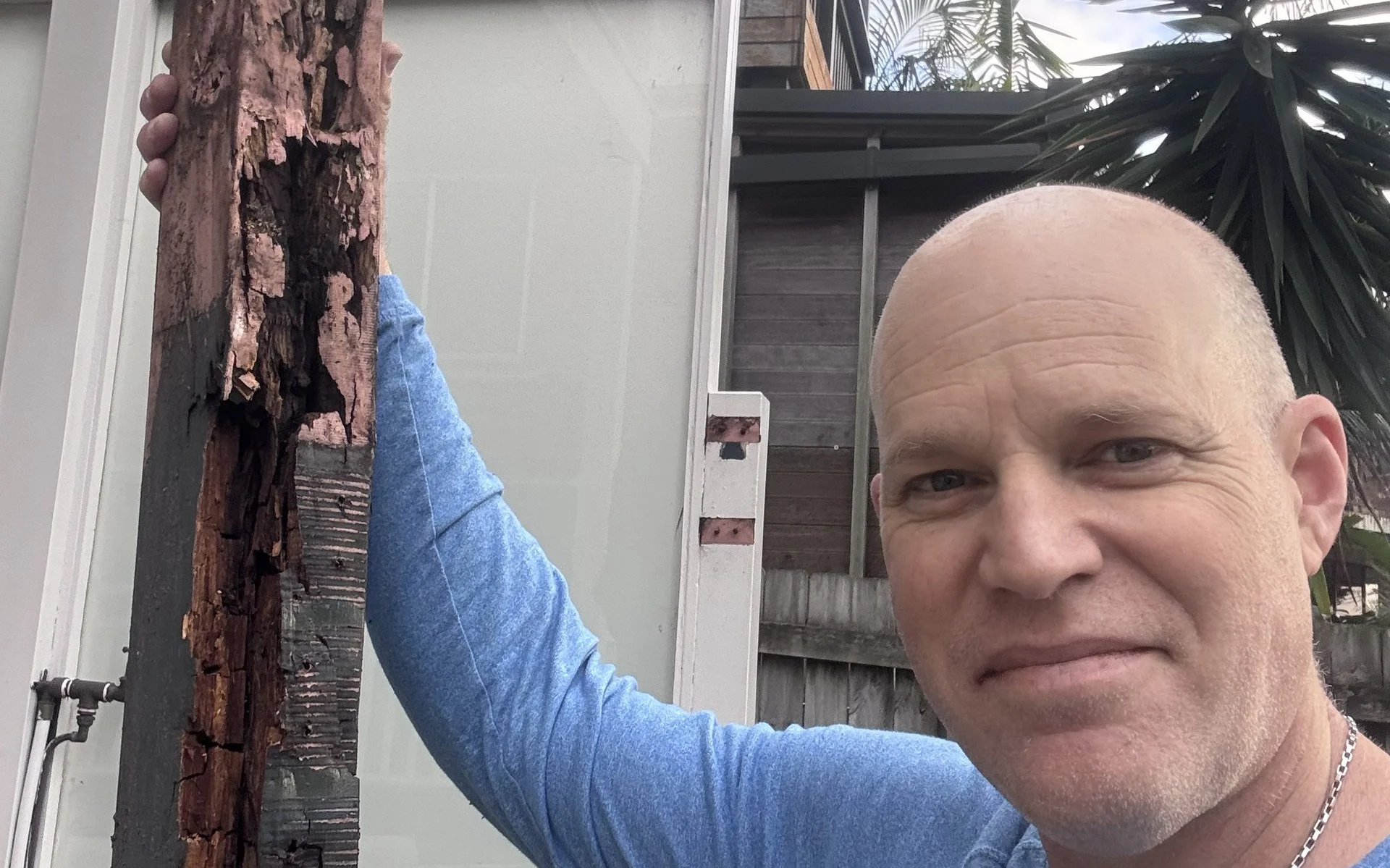
By the time you can feel softness through a deck board, the frame underneath has usually been failing for years. Joist tops rot first — they’re horizontal, they sit under boards that hold moisture, they’re often hidden from view and air. A spongy section above usually means the joists in that area are spent, and joists fail in clusters because the same conditions that killed one are killing its neighbours.
This is the inspection most repair-quote calls turn into. Client expects a half-day board swap. I show them what’s actually under the boards. The conversation changes.
By the time a client can feel softness underfoot, the frame has usually been failing for years. Spongy boards aren’t a repair signal — they’re a “lift a board and look” signal.
When a Repair Is Genuinely Worth Doing
A repair makes sense when the problem is contained, the rest of the structure is sound, and the repaired section will outlast the deck around it. Real examples:
- A board or two that’s split or cracked from impact damage, frame underneath fine
- A stair tread that’s worn through, stringers and risers fine
- A section of balustrade where a baluster has snapped, post structure fine
- A patch of joist rot under a downpipe drip line that’s been there for years — fix the drip, replace the localised framing, sleep at night
The common thread: the rest of the deck has years of life left in it, and the repair brings that one failure point back up to the standard of the surrounding work.
The Budget-Fit Repair (When It’s the Right Call)
I’ll give you a real one. A client had a low-set deck — about 100mm off the ground — built years before they bought the place. The frame had been installed with H3 treated pine, but at that height to ground, you really need H4. The deck wasn’t dangerous, but sections were bouncy under foot. The frame had started giving way in patches.
Full replacement was the right answer. The client’s budget wasn’t.
What we did was repair the worst section — strip the boards over that area, replace the failing framing with H4, put the boards back where they could be saved. I was straight with them: the rest of the frame is the same age, built the same way, in the same conditions. Expect another section to need the same treatment within a couple of years.
Two years later, the call came in. Same deck, different section. Repaired that one too. There’s a third call coming and we both know it.
Was it cheaper to do this in stages than rip-and-replace? Probably not, when you tally it up. Was it the right call for this client at that time? Yes. Sometimes the budget decides, and the job is to be honest about what staged repairs actually mean — not pretend they’re a permanent fix.
When I Won’t Do a Repair
There are repairs I’ll walk away from. A client describes a problem, I look at it, and I can tell the repair they’re asking for will fail. Maybe the frame has gone too far. Maybe the structural fix they want is cosmetic only. Maybe they want me to put my name to something that I know won’t last.
No self-respecting deck builder will put their licence number on a repair that’s going to fail. If a client insists on a patch-up I don’t believe in, I’d rather walk away than do the work and have it come apart on me. The reputation cost outlasts the job by years.
If you ring around and three builders all say “this needs replacing, not repairing” — listen. They’re not coordinating. They’re seeing the same thing.
The Frame Trap (Why “Just Replace the Boards” Almost Never Works)
This is the section most homeowners don’t see coming.
When boards are shot but the rest of the deck “still seems fine,” the obvious idea is to replace just the boards and keep the existing frame. Save half the cost. Faster job. Everyone’s happy.
In my early days I’d say yes to this where I could. I’m a people pleaser by nature — working on it — and the client’s logic seemed sound. Over time I stopped doing it except in unusual cases. Here’s why.
Demolition vs Meticulous Removal
Ripping a whole deck out — boards plus frame — is a fast, brutal job. Pry bar, demolition saw, dump it in the skip. Done in hours.
Taking only the boards off, while keeping the frame intact and undamaged enough to build on, is the opposite. Every screw or nail comes out individually. Boards have to come up without smashing the joist tops. Anything that splits the framing or marks the top of a joist creates a new problem to fix. That meticulous removal can take days, not hours. The labour cost stacks up quickly.
The Old Frame Always Needs Work
Once you’ve stripped the boards, the frame is exposed for the first time in years. What you see is almost never what the client hoped for. Weak spots that need timber hardener. Joists that need sistering. Levelling that’s drifted because the frame has moved. Missing or bent fixings. Bearer ends rotted at the post tops.
And if the new deck uses different board widths or layouts — composite picture-framing, breaker boards, ladder patterns, perimeter boards over a different joist spacing — additional framing has to be installed to support that. You’re partway to a new frame by the time you’re done.
The Lifespan Mismatch
Here’s the part that closes the argument. The boards going on are almost always going to be composite — Millboard, Trex, EvaLast, that grade — because that’s the upgrade people make when they replace timber decking. Composite boards carry 25 to 50 year warranties.
The frame you’ve kept is twelve, fifteen, twenty years into a thirty-year frame lifespan. It has maybe ten to fifteen years left, depending on how it was built and where.
You’re putting a 50-year board on a 15-year frame. In ten years you’re lifting brand-new composite boards to fix the frame underneath. That’s not a deck investment. That’s a deferred bill with interest.
The Cost Reality
Once you add up the meticulous removal time, the frame remedial work, the additional framing for the new board layout, and the headache of warrantying a new board over an old frame — the cost of “just replacing the boards” usually lands within striking distance of a full rip-and-replace. And the full replacement gives you a frame matched to the boards, built right, warrantied as one job.
In the Eastern Suburbs where most decks are under 50m², the maths almost always favours starting fresh. Bigger decks the calculation gets closer, but the lifespan-mismatch problem doesn’t go away.
A 50-year board on a 15-year frame isn’t half a new deck. It’s a 15-year deck with a 35-year cosmetic upgrade nobody asked for.
A Quick Comparison
| Situation | Repair makes sense | Replace makes sense |
|---|---|---|
| One specific damaged board or stair tread | ✔️ | |
| Localised rot from a known water source (gutter drip, etc.) | ✔️ | |
| Spongy spots in more than one area | ✔️ | |
| Multiple boards weathered, splitting, or lifting | ✔️ | |
| Wobble or movement across the whole deck | ✔️ | |
| Frame age 15+ years and showing signs | ✔️ | |
| Client wants composite over old timber frame | ✔️ (almost always) | |
| Deck looks tired but no specific defect | ✔️ (depends on age) | |
| Budget doesn’t stretch to replace, deck still safe | Staged repair, with honesty about what’s coming |
What an Honest Inspection Looks Like
A deck builder coming to assess repair vs replace shouldn’t be glancing from the surface and quoting on the spot. The inspection that gives you a real answer involves:
- Lifting a board in two or three different locations to see joist tops
- Checking under the deck where access allows — looking for ledger flashing, bearer condition, post bases
- Walking the surface deliberately, finding any softness
- Looking at fixings, stair connections, balustrade post anchorage
- Asking when the deck was built, by whom, and out of what (if known)
If the assessment is a five-minute walk-on and a quote handed over the same visit, you’re getting a guess. The questions that flush out the right builder for a job like this overlap heavily with the questions I’d ask any deck contractor before signing.
What I Tell Clients to Ask Themselves
Before you commit to repair or replace, sit with these:
- How long do you plan to stay in the house? A short-term hold makes repair more defensible.
- Are you trying to sell? A tired deck hurts the inspection report and the photos. Replacement usually pays back in the sale price.
- Is there one specific failure or a general decline? Specific is repair territory. General is replace territory.
- What’s the frame age? If you don’t know, find out before you commit a cent.
- Are you willing to live with the deck looking the same as it does now, just with the failed bits fixed?
That last one is the question most people don’t ask. A successful repair gives you the same deck you had, minus the obvious failure. If the deck already feels old and you wouldn’t want a photo of it on your patio, repair won’t change that.
Red Flags in Repair Quotes
A few warning signs to watch for if you’re getting repair quotes:
- “We’ll just swap the rotten boards and you’ll be right” — without lifting anything to check the frame
- A repair quote that doesn’t name which boards, which joists, or which fixings
- No mention of warranty on the repair itself
- A flat fee with no inspection of what’s actually under the deck
- A quote within the same visit, no time to assess properly
- Refusal to discuss replacement cost as a comparison — a good builder will tell you both numbers
If repair is genuinely the right call, the builder will walk you through why, what’s covered, what’s not, and what they expect the timeline to be before the next issue appears. Vague answers there mean you’re being sold to.
For broader signals of a builder you can trust on either path, the warning signs worth knowing apply just as much to repair work as to new builds.
Where The Decksmith Sits
I’m the lead carpenter on every build and every repair I take on. Licence 272840C. Where a job needs more hands I bring on a small team — but you won’t get the junior carpenter and apprentice showing up to look at your deck.
If you’re weighing repair against replacement, the honest assessment is the one thing you actually need from a builder at this stage. Not a sales pitch. A look under the boards, a real conversation about frame age, and the maths on what each option actually costs over the next decade. That’s the conversation worth having.
If you’d like to get a rough sense of where a replacement might land before we ever speak, the pricing calculator at the-decksmith-pricing-guide.netlify.app gives a realistic range based on your specs. No email gate. If you want a feel for the post-handover experience that comes with a Decksmith build, my Google reviews are the place to look.
If the answer is repair — get it from someone who will tell you straight when it isn’t. If the answer is replace — get it from someone who’ll match the frame to the boards and stand behind both. Either way, the worst outcome is a half-job that has you back in the same conversation in three years.
Get Your Deck Estimate
Use the calculator to see indicative pricing for your project.
Open Calculator