
From The Workshop
When a Sydney Timber Deck Is Past Saving (And What Replacement Actually Involves)
I get called to Eastern Suburbs houses and townhouses where the owner already knows something is wrong. Soft spots underfoot. Boards that bounce. A post that feels spongy when you lean on the rail. The question is rarely "does it look tired?" - it is "is this deck past saving?"
After 13+ years building and replacing decks across Sydney's Eastern Suburbs, that triage is half the job. This is not a general deck replacement service overview. It is the honest read I walk through on site before anyone talks materials or dates.
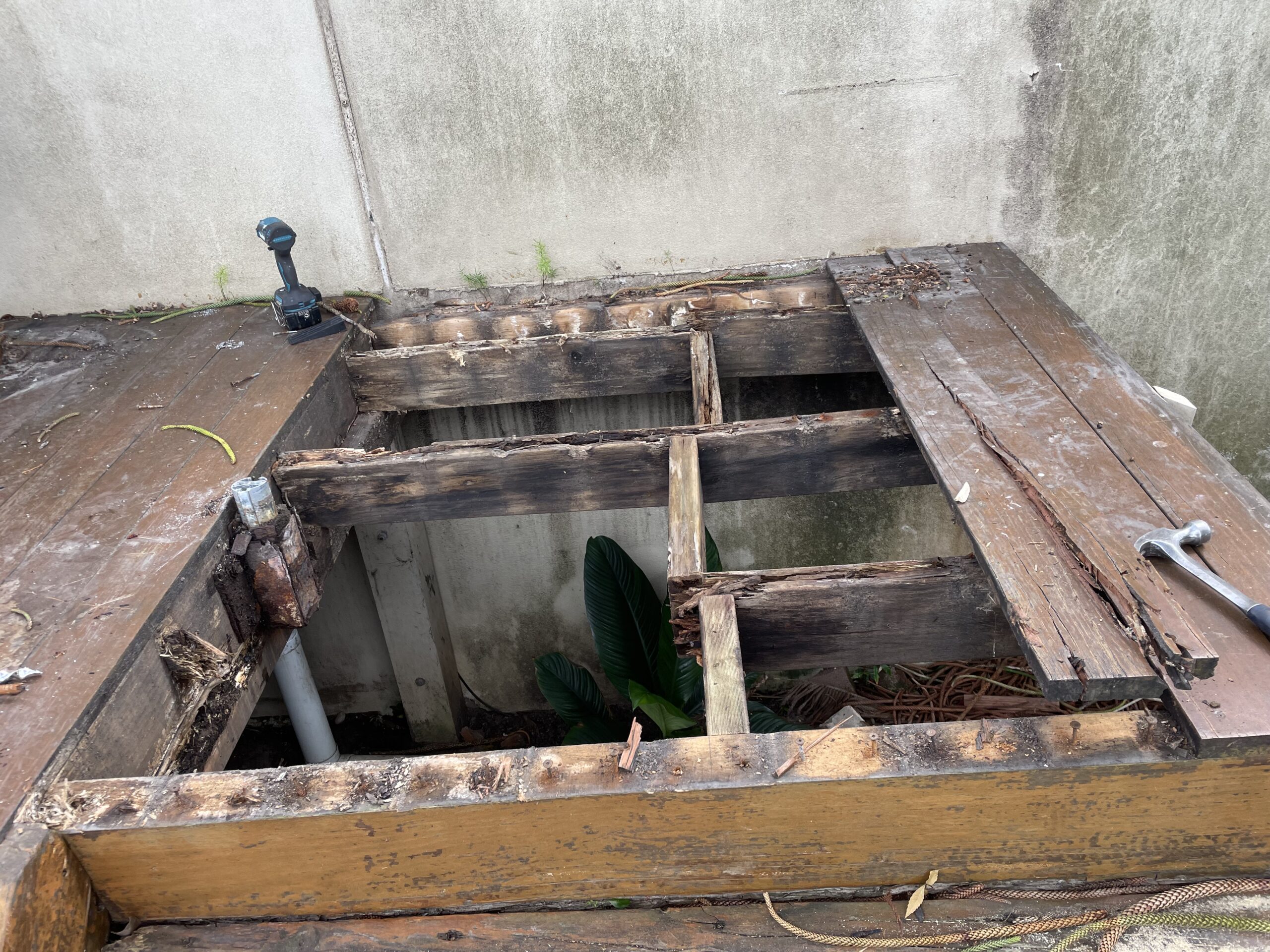
Soft spots and bounce are not cosmetic. By the time you can feel them, I am usually looking past the boards and into the frame.
Signs the Deck Is Cooked
A few patterns show up again and again on older timber decks around Bondi, Coogee, Maroubra, Randwick, and the harbour-side suburbs:
- Boards that give underfoot in more than one spot - not a single ding from a dropped pot
- Bounce or spring across a bay of joists, especially near stairs or the house connection
- Dark staining, mushrooming, or crumbly timber at post bases and bearer ends
- Rails that flex, or fixings that have pulled and been "tightened" more than once
- A deck that was patched board-by-board over years and still feels worse each season
One soft board can be a repair. Softness in a pattern usually means the structure underneath has been failing quietly for a long time.
Boards vs Frame - What You Are Actually Replacing
Homeowners often ask me to "just replace the boards." I understand why. The boards are what you see. The frame is what you stand on.
Boards weather. Frames rot from the top of the joist down, hold moisture under covered spans, and fail in clusters. On coastal Eastern Suburbs sites the frame usually fails first — more on that in coastal deck framing. If I lift a board over a spongy section and the joist tops are gone, new boards on that frame are a short delay - not a fix.
On a full replacement I am usually stripping the old surface, assessing (and often rebuilding) the frame to a standard that will carry the new decking, then rebuilding access, stairs, and balustrade as the site needs. That is a different job to a board swap. More on how I approach the full rebuild sits on my Eastern Suburbs deck replacement page; the point here is the triage - boards alone rarely solve a cooked structure.
There is also a hidden-cost angle most quotes gloss over. Proper, code-compliant framing often needs excavation for footings, or better treated members and detailing that a dodgy installer skips because the client cannot see it until years later. If a price only covers what you can see from the lawn, ask what is happening underneath.
When Repair Is Throwing Good Money After Bad
I will repair when the failure is contained and the rest of the structure still has real life in it. I will not pretend a scatter of soft spots on an ageing Eastern Suburbs timber deck is a weekend patch.
Repair becomes wasteful when:
- Multiple bays are soft or bouncy - you are chasing a frame, not a board
- Previous "repairs" keep reappearing in neighbouring sections
- The deck height, ground clearance, or original framing method was wrong for the site from day one
- Someone wants new hardwood or composite laid over a frame I would not put my name on
I also get called to fix dad-builds that cannot be made code-compliant without starting again - one hard conversation, then we plan a proper replacement rather than dressing up a problem.
If three people independently tell you it needs replacing, that is not a sales chorus. That is the same frame talking.
What Replacement Involves on an Eastern Suburbs Site
Eastern Suburbs houses and townhouses rarely give you a clean open site. Access is often a side path, a neighbour's goodwill, or crane/hoist thinking for materials. Strip-out means old timber out without wrecking gardens, pool surrounds, or shared walls. Then rebuild - footings and frame done properly, new decking, stairs and balustrade as required, and a finish that suits how you actually use the space.
I do not quote a flat rate per square metre. Height, materials, frame method, access, balustrade, and stairs change the job. Per-metre prices tend to pad "fat" to cover unknowns; I would rather walk the site and price the work that is actually there.
On a typical replacement I am often on site for several days once we start - many land around four to five days depending on size and access - and there is usually a lead of a few weeks before that start date. Permits and approvals sit with you as the client; if you need drawings or an approvals pathway, I can point you to a company that handles that.
What I Check at Consultation
Consultation is a site read, not a phone guess and not a race to the cheapest number. When I come out I am looking at:
- Where it is soft or bouncy - and whether that maps to frame failure
- Post bases, bearer ends, house connection, and stair stringers
- Ground clearance, drainage, and anything trapping moisture under the deck
- Access for strip-out and rebuild on your particular block
- Whether a contained repair is honest - or whether replacement is the only durable answer
I will tell you straight if it is past saving. If it is not, I will say that too. Licence 272840C sits on the work I stand behind either way.
Book a Consultation
If your timber deck feels soft, bouncy, or simply finished, I will walk the site with you and give you a straight read - repair where it is honest, replacement where it is not.
Book a Consultation
Book a Consultation
Tell me a little about your project and I’ll call you back to set up a site visit. Prefer to talk now? Call or text me on 0468 486 290. Licensed NSW carpenter (Lic. 272840C).